
Display Cart vs. Wood Liquor Fixture: Which Red Wine Display Fits Your Store?
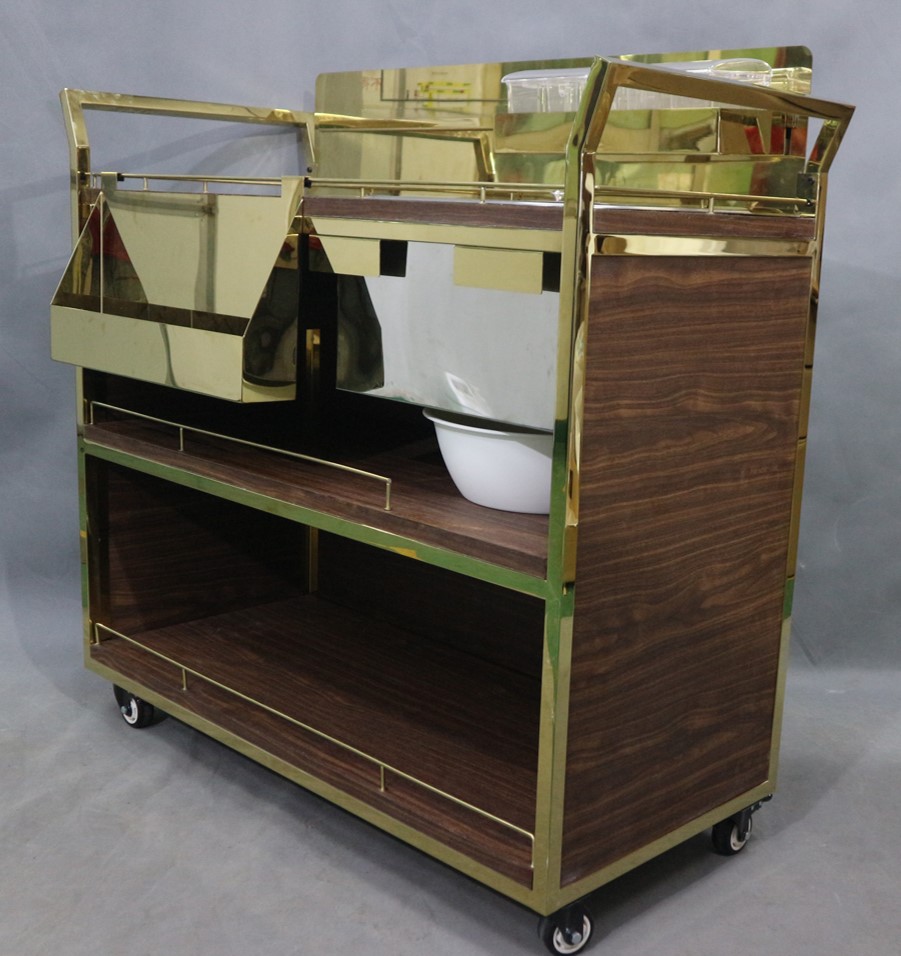
A display cart is specified for movement: the wine display follows the event, the service point or the promotion.
A red wine display has to hold bottles securely, stay readable from the aisle, and survive daily handling by staff and shoppers. Once the shortlist narrows to a push-type display cart and a freestanding wood fixture, the deciding factors are usually movement, floor footprint and who owns the display's job — not appearance.
The short answer. Choose the tuiche001 metal wine rack trolley when the red wine display must travel: it is a push-type metal trolley with a customizable white finish, intended for hotels, parties and brand promotion. Choose the LZ00023 wood liquor display fixture when the display should hold one position for months at a time: it is a wood fixture with a stated size of 40 × 40 × 160 cm, intended for shopping malls, supermarkets, catering and retail. The trolley is designed to be repositioned; the wood fixture is designed to be placed, merchandised and maintained.
Both are ECO DDL products. This guide compares them on the facts supplied for each item, adds the manufacturer information the company publishes about its own production, and flags every specification that is not stated in the available material as an item to confirm in the quotation. No load rating, wheel specification, price or lead time is assumed for either product.
What actually differs: movement, footprint and ownership of the display
Most fixture comparisons are framed as a material question — metal or wood. For red wine that framing misses the expensive part. A display in the wrong place at the wrong time costs staff minutes every day, and a display that gets dragged when it was built to stand still costs repair time. Two questions separate the formats quickly.
- Does the display change location during a trading week or a campaign? If yes, the format must be designed to move, not merely possible to move.
- Does it hold a fixed position in a fixed planogram? If yes, a stable, compact footprint is worth more than wheels.
A second distinction runs through both answers. The tuiche001 is described as a push-type trolley: movement is part of its design intent, so cost is built into the structure. The LZ00023 is described as a movable wood fixture: it can be repositioned, but the practical routine is to empty the shelves, move the unit and re-merchandise. Buyers who read “movable” as “pushable” often buy one format and use it as the other.
The tuiche001 metal wine rack trolley: built to be pushed
The tuiche001 is a metal wine rack trolley with a push-type design and a customizable white finish. Three practical consequences follow from that description.
Push-type movement
The unit is intended to be pushed along the floor rather than carried. Before ordering, walk the route: doorway widths, thresholds, floor transitions, lift openings, turns and the position where the cart is stored when it is not in use. A cart that cannot clear a threshold becomes a fixed fixture with extra parts, and that is a layout problem rather than a product fault.
Metal construction with a white finish
Metal is the material named for this unit and white is offered as a customizable finish. A white cart reads as neutral in hotel and event spaces and can be repeated across several venues against one finish reference. Ask for a physical finish sample, and confirm in writing what the finish is expected to tolerate in cleaning and handling. The exact white reference, the coating system and any finish warranty are not stated in the available product material.
Hospitality and promotion profile
The stated applications are hotels, parties and brand promotion — settings where the display is part of the service or the campaign, and where it may need to be set up, used and removed within the same day. In the supplied product material, bar and restaurant environments, brand promotional events and activities, and liquor market rack displays are the settings most often associated with this kind of movable wine display.
Not stated in the supplied material for the tuiche001: bottle capacity, shelf spacing, load rating, wheel type and braking, overall dimensions including the push point, and unit weight. Each belongs in the enquiry, not in an assumption drawn from the product name.
The LZ00023 wood liquor display fixture: a fixed merchandising anchor
The LZ00023 is a wood liquor display fixture with a stated size of 40 × 40 × 160 cm and stated applications in shopping malls, supermarkets, catering and retail.
Read the dimensions as a planogram input
A 40 × 40 cm base is a compact square footprint — useful where the display has to sit inside an existing run of shelving or at the end of an aisle without consuming a large floor area. At 160 cm high, the top of the unit sits roughly at chest-to-eye level for a standing adult, so upper rows are read at a glance while lower rows are reached by hand. Check the stated footprint against the shelf run or aisle you have in mind, and add clearance for access and cleaning; those clearances sit outside the 40 × 40 cm base.
Wood means a different maintenance routine
Wood is the material named for this unit, and ECO DDL operates its own wood product workshop. What the available material does not state is the wood species, the finish, the edge treatment or moisture performance. For a supermarket or mall installation those details decide how the unit looks after a year of cleaning, so request them in writing rather than inferring them from the format.
Movable is not the same as push-type
Because the unit is described as a movable wood fixture, it can be repositioned. Treat that as a planned task — empty the shelves, move the unit, re-merchandise — rather than as daily flexibility. If the display has to shift every week, the trolley is the better tool.
Material and customization: what white metal and wood each commit you to
Both products come from a manufacturer that lists metal, acrylic, wood and plastic among its production materials and runs its own hardware, acrylic, wood product, powder coating, silk screen and packaging workshops. The practical value of that is not promotional: a mixed order of metal trolleys and wood fixtures can be specified, sampled and shipped as one programme instead of two.
Customization is not symmetrical. The tuiche001 is explicitly offered with a customizable white finish, which is the lever most buyers use to match a store palette or a campaign identity. For the LZ00023, only the material and the 40 × 40 × 160 cm size are stated in the available product material; finish and detailing remain open questions for the supplier.
The trade-off to weigh before ordering:
- Consistency across a chain. A white metal trolley can be repeated across sites against one finish reference. Wood varies more visibly in tone, so if you need several units, specify them together.
- Wear and touch-up. A coated metal edge that chips leaves a visible mark; wood that takes a knock shows a dent. Neither is a defect of the format — both are reasons to keep the display clear of trolley traffic and door swings.
- Cleaning regime. Confirm what each finish tolerates before a store team adopts its usual cleaning chemical, because that decision is made in the store, not in the procurement office.
Choosing in six steps
- Write the display's job in one sentence. “Hold red wine in a fixed position on the retail floor” and “carry red wine into a function room” are different briefs with different answers. Write the sentence before comparing specifications.
- Walk the movement route. If the display will move, measure the narrowest point on the route — doorways, lift openings, turns, thresholds — and compare it with the unit's overall dimensions. The LZ00023's stated 40 × 40 × 160 cm gives a starting envelope. For the trolley, request the overall dimensions including the push point, because the push point usually adds to the shelf footprint.
- Set a repositioning frequency. Daily or weekly movement points to the tuiche001; once or twice a year points to the LZ00023. Anything in between is a judgement call, and the cost of getting it wrong shows up as staff time rather than as purchase price.
- Match the finish to the environment. White is the stated customizable finish for the trolley — confirm the exact white against your fixture palette and request a sample. For the wood fixture, ask for species, finish and cleaning guidance in writing.
- Check the documentation trail for your destination market. In the United States, UL Solutions evaluates retail fixtures and merchandise displays under UL 970, and applicability must be confirmed for the specific product and installation. Metal display fixtures are frequently traded under HS Code 940320, which is a classification starting point for import paperwork rather than a product specification. Ask which documents travel with the shipment: material declarations, finish data and packaging details.
- Sample before committing to a quantity. A sample is the only reliable way to test the two things a specification sheet cannot show: how the unit behaves when it is moved, and how the finish reads under your store lighting. Push the loaded trolley across the actual floor surface; place the wood fixture in its intended position and check the envelope against the aisle.
Where each format earns its place
A hotel wine display that has to appear in a lobby before an evening event and disappear afterwards is a logistics problem as much as a merchandising one. The tuiche001's stated settings — hotels, parties and brand promotion — describe exactly that pattern, and they align with bar and restaurant environments, brand promotional events and liquor market rack displays.
A supermarket or mall installation is the opposite problem. The fixture is positioned once, merchandised to a planogram, replenished from the back and cleaned around for months. The LZ00023's stated settings — shopping malls, supermarkets, catering and retail — describe that pattern, and its compact 40 × 40 cm base suits a defined position inside an existing run rather than a free-standing island.
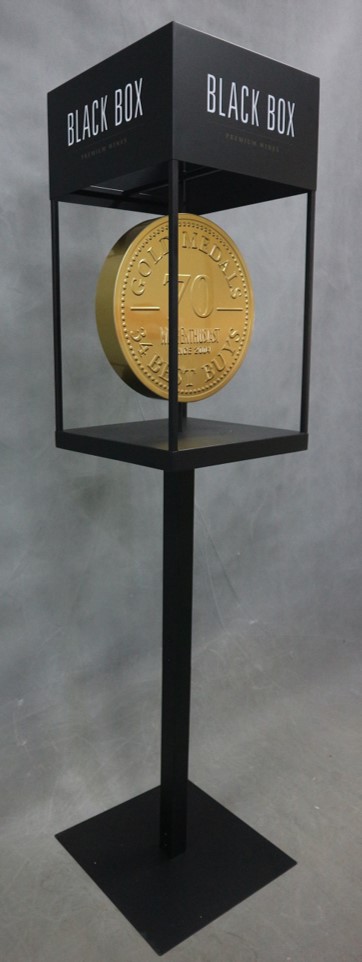
Height and base footprint decide how a wine display reads from the aisle and how easily it is replenished.
Catering sits between the two. A catering operation may serve in a fixed venue and also work events; in that case the honest answer is often one of each — the wood fixture in the venue's permanent display position, the trolley as the unit that leaves the building.
Worth checking before you order: if the trolley has no assigned route and no named owner, it will end up stationary in a corridor, and you will have paid for mobility you never used. Flexibility only pays when someone is responsible for exercising it, so write that responsibility into the store routine first.
Hotel and event service is the setting where a movable wine display is most often specified.
tuiche001 vs. LZ00023: side-by-side comparison
| Decision factor | tuiche001 metal wine rack trolley | LZ00023 wood liquor display fixture |
|---|---|---|
| Format | Wine rack trolley with push-type design | Freestanding liquor display fixture |
| Material | Metal | Wood |
| Movement | Designed to be pushed; movement is part of the design | Described as movable; repositioning is a planned task |
| Stated size | Not stated in the supplied material — request overall dimensions including the push point | 40 × 40 × 160 cm |
| Customization | Customizable white finish | Not stated in the supplied material |
| Stated settings | Hotels, parties, brand promotion; also associated with bar and restaurant environments and liquor market rack displays | Shopping malls, supermarkets, catering, retail |
| Best fit when | The display changes location within a week or within a campaign | The display holds a fixed position and is merchandised to a planogram |
| Confirm before ordering | Overall dimensions, load expectations, wheel type and braking, finish sample | Wood species and finish, base footprint tolerances, cleaning guidance, stability on your floor |
Sourcing both formats from one manufacturer
ECO DDL — Dongguan Display Leader Co., Ltd — was established in 2013 and describes itself as a professional display manufacturer providing one-stop design and customized solutions for retail product displays, POP displays, display cabinets and display props. The company reports a 40,000 m² manufacturing base in Dongguan, Guangdong, 420 professional and technical staff, a 30-person R&D team and a 36-person quality team, with its own hardware, acrylic, wood product, powder coating, silk screen and packaging workshops. It states an export share of 95% with main markets in the USA, Europe, Northern Europe, Japan, Russia and the Middle East, and reports an annual output of 300,000 units and capacity of more than 900 containers a year.
These are company-reported figures. They matter to a buyer because they show that a metal trolley and a wood fixture can be produced and finished under one roof, which simplifies a mixed order and keeps one point of accountability for packaging and shipment. They are not a substitute for your own verification: request the current specification sheet, the finish sample and the documentation package for your destination market.
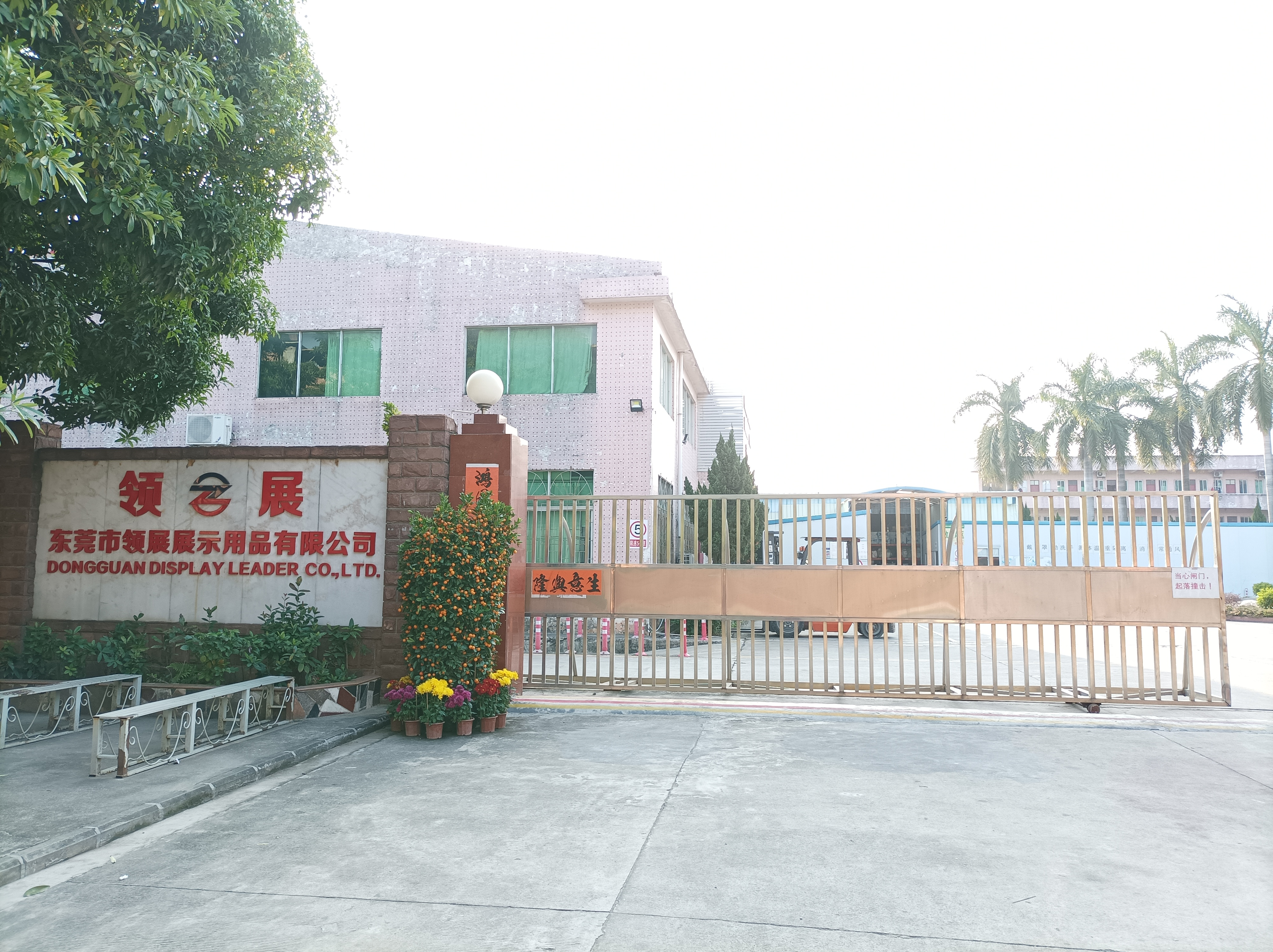
ECO DDL reports a 40,000 m² base in Dongguan with in-house metal, wood, powder coating and packaging workshops.
For a US-bound project, the compliance conversation starts with the fixture standard rather than the brochure: UL Solutions identifies UL 970 as the standard for retail fixtures and merchandise displays, and assesses applicability per product and installation. Put that question into the supplier enquiry instead of assuming one certificate covers every unit in a range.
FAQ: red wine display carts and wood liquor fixtures
What compliance checks apply to a display cart or a wood liquor fixture?
Start with the retail fixture standard for your destination market. In the United States, UL Solutions evaluates retail fixtures and merchandise displays under UL 970, and applicability depends on the specific product and installation, so the check belongs in the enquiry rather than in an assumption. Metal display fixtures are frequently traded under HS Code 940320, which supports import classification but does not certify the product. If illumination or any electrical component is added to a display, additional electrical requirements apply and should be specified separately.
Can the tuiche001 be supplied in white to match our store palette?
Yes — white is the stated customizable finish for the tuiche001 metal wine rack trolley. Two practical steps follow: request a physical colour sample to check under your store lighting, and confirm in writing what the finish is expected to tolerate in cleaning and handling. The available product material does not state the exact white reference, the coating system or a finish warranty, so those points belong on the quotation.
Which of the two is cheaper?
No price is published in the available product material for either item, so a cost ranking cannot be stated honestly here. What can be compared is the cost structure: material and finish, quantity, packaging, freight, and the staff time consumed by moving or re-merchandising the unit. The trolley's ownership cost includes the route it travels; the wood fixture's includes the finish and cleaning routine it must survive. Ask for a like-for-like quote using the same quantity, destination and documentation requirements, so the comparison is between products rather than between two commercial assumptions.
Can we evaluate a sample before placing a bulk order?
Sample terms are not stated in the available material, so ask the supplier directly. When a sample does arrive, test the two things a specification sheet cannot show: how the unit behaves when moved, and how the finish reads in your lighting. Push the loaded trolley across the real floor surface and through the narrowest point on its route; place the wood fixture in its intended position and check the 40 × 40 × 160 cm envelope against the aisle, the shelf run and the cleaning access around it.
What lead time should we plan for?
Lead time depends on specification, quantity, finish and destination, and the available material does not state a verified lead time for either product. The reported annual output of 300,000 units and capacity of more than 900 containers describe manufacturing scale, not a delivery date. Ask for a written lead time tied to your bill of materials, confirm it in the purchase order, and add a buffer for the sample round and finish approval. To compare both formats on the same terms, send the store layout, the event calendar and the finish reference to ECO DDL in a single enquiry so both items are quoted against one brief.
Conclusion: decide on movement, confirm on specification
- If the red wine display has to be somewhere else next week, specify the tuiche001 metal wine rack trolley. It is the format designed to be pushed, and its customizable white finish makes it repeatable across hotel, event and promotion settings.
- If the display will hold a position and be merchandised to a planogram, specify the LZ00023 wood liquor display fixture. Its stated 40 × 40 × 160 cm size makes it straightforward to plan into a mall, supermarket, catering or retail floor.
- If you genuinely need both, order them as one programme from the same manufacturer: one finish reference, one documentation pack, one shipment.
Either way, the questions that decide satisfaction sit outside the product name — overall dimensions including the push point, load expectations, a finish sample, the cleaning regime and destination-market documentation. Settle those in writing before the order, and the choice between a cart and a wood fixture becomes a short, defensible decision.
For the full product and capability reference — factory, workshops, materials and product ranges — download the ECO DDL company profile: Company profile (PDF).
ECO DDL · Dongguan Display Leader Co., Ltd · No.2 DaXi Road, Dazhou Community, Qiaotou Town, Dongguan, Guangdong, China 523525 · ecoddl-display.com
Have Questions or Need More Details?
Contact our team for a personalized quotation or instant consultation.
Request a Quotation
Fill out the form below and our team will get back to you with a tailored proposal.
WhatsApp Direct Chat
Prefer to chat in real-time? Message us on WhatsApp for instant assistance & quick answers.
- Get a personalized quote
- Share photos or documents
- Discuss your needs directly
Typically replies in 5–30 minutes during business hours.