
Liquor Display Fixtures vs. Bottle Fixtures vs. Wine Rack Trolleys
Short answer: the wooden LZ00023 liquor display fixture, at 40 × 40 × 160 cm and movable, is the format for a permanent red wine position in a mall or supermarket aisle. The metal LZ-019 bottle display fixture is the choice when bottle stability and wear resistance matter more than repositioning. The metal tuiche001 wine rack trolley, push-type movable with a customizable white finish, is the format when the same bottles have to travel between a restaurant floor, a hotel banquet room, and an evening event. Material, mobility, and footprint decide the answer long before price does.
ECO DDL (Dongguan Display Leader Co., Ltd.) is a display fixture manufacturer established in 2013 in Dongguan, Guangdong, China, operating a 40,000 m² manufacturing base with 420 staff and exporting roughly 95% of its output to the USA, Europe, Northern Europe, Japan, Russia, and the Middle East. All three formats below come from that range, so this comparison is built on the manufacturer's own product descriptions rather than on generic category language.
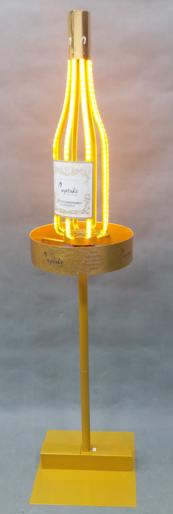
Why the three names get compared as if they were one product
All three products hold bottles upright in front of a buyer, and that is where the similarity ends. A liquor display fixture is normally a fixed-format presentation unit that occupies a permanent position in a store. A bottle display fixture is a merchandising platform built for repeated restocking and customer handling. A wine rack trolley is a service carrier: it exists to move stock, not to hold a floor position.
Because the labels overlap, procurement documents regularly compare things that are not interchangeable. A quotation for a 40 × 40 × 160 cm wooden tower can look expensive beside a trolley quotation, until the buyer notices that one buys a permanent vertical presence in the aisle and the other buys mobility. Neither is overpriced; they answer different questions.
Industry fixture taxonomies do not resolve the confusion either. Fit-out guidance classifies retail fixtures into wall shelving, gondola units, freestanding product tables, plinths and risers, glass display cases, drawer display units, illuminated wall units, hanging rails, sample display cabinets, and product demonstration counters. Bottle formats cut across several of those groups: a wine tower behaves like a freestanding unit, a bottle display like shelving, a trolley like a demonstration counter. The names describe where the fixture sits in the store, not how it works.
The practical fix is to stop comparing product names and start comparing four attributes that actually decide fit: material, mobility mechanism, footprint, and customization scope.
What the buying environment looks like in 2026
Market Research Future sizes the global retail display market — physical fixtures together with digital integration — at 39.87 billion USD in 2025, with growth projected through 2035 driven by experiential retail and sustainability (source: Market Research Future, retail display market report, 2026). Business Research Insights sizes the narrower structural fixtures segment — racks, shelving, and cases — at 2.62 billion USD for 2026. These two figures describe different industry layers and should not be added together or quoted as one number: the first includes digital displays and signage, the second covers structural furniture only.
For a buyer in the decision stage, the commercial reading of that growth pattern matters more than the totals. Experiential retail rewards floors that can be reconfigured — promotion resets, seasonal changes, tasting events — which is the reason movable formats and trolleys have a place next to fixed merchandising units instead of replacing them. Sustainability pressure works in the opposite direction: it favours durable, repairable fixtures that stay in service through several brand campaigns rather than disposable ones.
Two compliance layers now sit on top of the aesthetic decision. Metal display fixtures are frequently traded under HS Code 940320, which is the classification most buyers will see on customs paperwork (source: Market Research Future, 2026). For United States buyers, UL Solutions identifies UL 970 as the standard for retail fixtures and merchandise displays, covering commercial displays, showcases, and temporary displays; applicability is product- and installation-specific and should be confirmed before a purchase order is released (source: UL Solutions, retail fixtures and commercial displays). Where an illuminated or digital element is added, European requirements change again: Regulation (EU) 2019/2021 sets mandatory ecodesign requirements for electronic displays in the European Union. That regulation addresses electronic displays specifically, so a buyer specifying a lit fixture should confirm scope with the supplier and a testing partner rather than assuming the assembly falls inside or outside it.
Supplier capacity is the third layer. ECO DDL, established in 2013, runs in-house hardware, acrylic, wood product, powder coating, screen printing, and packaging workshops against an annual output listed at 300,000 units, with 30 R&D staff and a 36-person quality team. That multi-material structure is directly relevant here: the three formats compared in this guide are made of wood and metal, and having both processes under one roof reduces the risk of mismatched specifications when a project needs more than one fixture type.
The three formats, described on their own terms
LZ00023: the wooden liquor display fixture
LZ00023 is a wooden liquor display fixture listed at 40 × 40 × 160 cm and described as movable, with red wine display as its stated application. The two 40 cm figures define a compact base and the 160 cm figure the vertical presentation; confirm the axis order against your own drawings before an aisle plan is finalized.
What the format does well is vertical merchandising on a small floor area. A tall, narrow unit presents bottles across several heights along a short wall run, which suits mall brand zones and supermarket positions where floor space is measured in metres but the brand still wants presence. Because the fixture is movable, it can be repositioned for a seasonal reset without being replaced.
Where it loses is portability in service. It is not a carrier: if bottles have to leave the fixture for a table, a tasting counter, or a banquet, a trolley performs that task better. Buyers should also confirm what movable means in practice — casters or a two-person lift — because the answer changes the aisle width you need.
LZ-019: the metal bottle display fixture
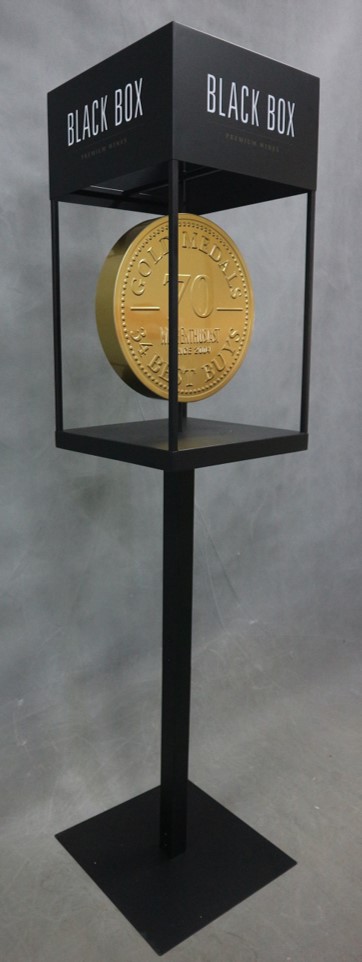
LZ-019 is a metal bottle display fixture; the manufacturer lists customizable material and describes the unit as stable and wear-resistant. That description points to the environment it was built for: a fixed position with heavy handling, where bottles are loaded and unloaded daily and the surface has to survive it.
Stability is the deciding property. In supervised bottle retail, hospitality back-of-floor areas, and any position where staff and shoppers reach in constantly, a platform that does not shift is safer than one that rolls. Wear resistance matters most where cleaning regimes are frequent and the same shelf edge takes repeated contact.
The customization axis here is material rather than colour. Buyers specifying for a particular environment should confirm gauge, finish, and shelf configuration in the RFQ, because the published description covers material customization and stability rather than dimensions. Metal bottle display fixtures are also the format most consistently handled under HS Code 940320 in trade documentation.
tuiche001: the metal wine rack trolley
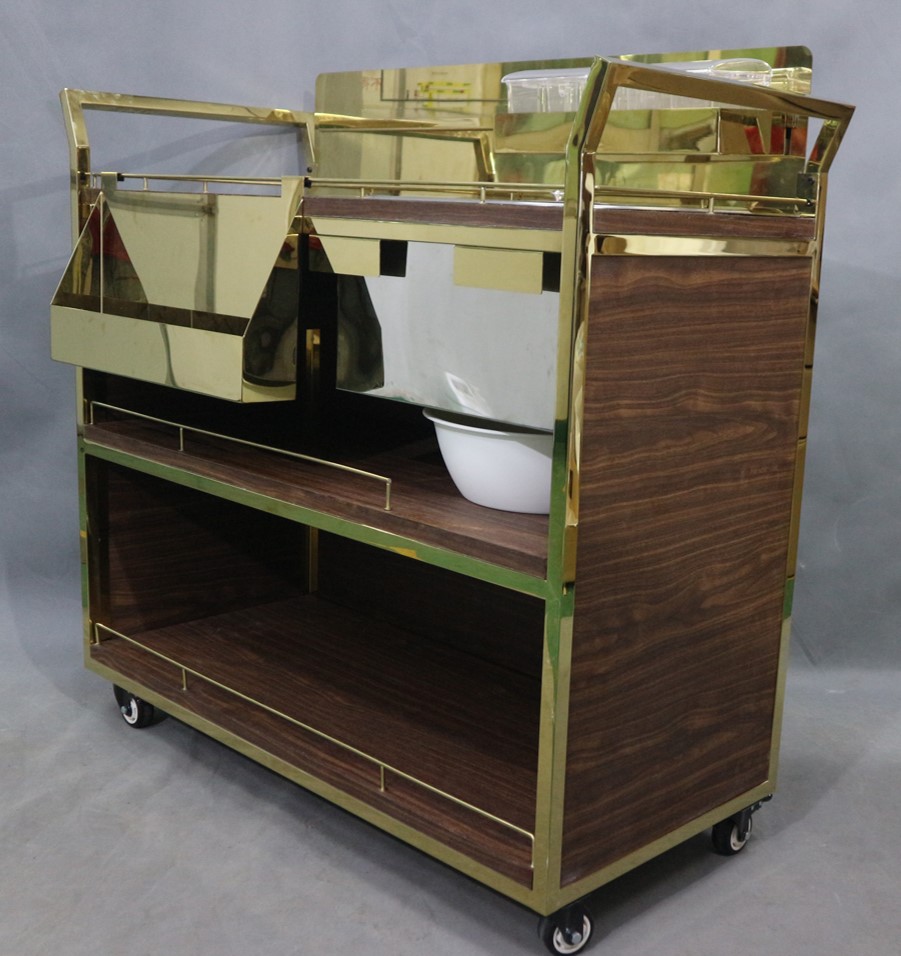
tuiche001 is a metal wine rack trolley described as push-type movable, with white available as a customizable finish. Its job is movement: in a restaurant or hotel it is the bridge between storage and the point of service, and at an event it is simultaneously the display and the supply point.
The application set is specific. ECO DDL positions its bar and event display range for bar and restaurant environments, brand promotional events and activities, and liquor market rack display scenarios — the three contexts where a fixture has to be somewhere different at 7 p.m. than it was at 7 a.m.
The trade-off is concentrated in the moving parts. A trolley puts wear into the mobility mechanism and the finish, so the RFQ should state the load it will carry, the floor surface it will roll across, and whether the white finish is a coating that will need touch-up during service life. Those three questions separate a trolley that lasts from one that is rebuilt in year two.
Where these three sit in the wider display fixture range
Bottle and trolley formats are one slice of a broader catalogue. ECO DDL's range also covers high end display fixtures, 3C digital display fixtures, fast selling display fixtures, snack display fixtures, illumination display fixtures, display carts, wooden end caps, acrylic compartment display fixtures, and acrylic stand display fixtures. For a multi-category retail project, sourcing several of these from one manufacturer reduces the risk that fixtures specified for the same aisle arrive in different finishes or at different heights.
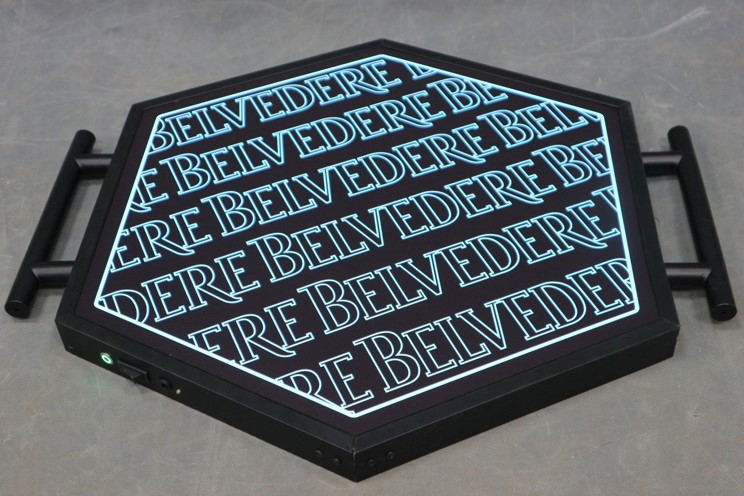
If an illuminated element is added: a lit version of any bottle fixture becomes an electrical product, not just a furniture item. ECO DDL's risk controls for illuminated products cover overheating, water exposure, and packing breakage, using a supplied electronic adapter, protective foam packaging, and aging testing run in-house or at outsourced certified labs. Fit-out guidance also recommends coordinating shelf heights with lighting, managing glare, specifying colour temperature, and routing electrical connections before the fixture is ordered — decisions that are difficult to reverse after production.
How to run the selection, step by step
- Describe the route, not the product name. Write down where the bottles arrive, where they are stored, and where they must stand in front of a customer. If those three locations are the same place, a fixed fixture is enough. If they differ, you are buying mobility.
- Classify the fixture as fixed, movable, or pushed. LZ-019 is described as stable; LZ00023 is described as movable; tuiche001 is described as push-type movable. Only the third is designed to be in motion during service.
- Fix the footprint in numbers before comparing quotations. LZ00023 is listed at 40 × 40 × 160 cm. For LZ-019 and tuiche001 the published description does not state dimensions, so both need to be quoted to your own space rather than assumed from a catalogue photograph.
- Match material to handling intensity. Wood suits presentation positions where the fixture is part of the shop fit. Metal suits daily restocking, cleaning, and constant contact — which is why wear resistance appears in the LZ-019 description rather than in a decorative claim.
- Write the customization scope into the RFQ. For LZ-019 the axis is material; for tuiche001 it is the white finish; LZ00023 is presented as a fixed specification. State precisely which of these you are asking the factory to change.
- Scope compliance by destination market and by electrical content. Confirm HS classification for metal units, confirm whether UL 970 evaluation applies to a US installation, and confirm the electrical scope if the fixture is lit.
- Approve a sample before volume production. Sign off finish, stability, mobility mechanism, and packaging protection on a physical unit — not on a rendering.
Use cases: which format survives which environment
Shopping malls and brand zones reward vertical presence in a small plan area, which is where a 40 × 40 × 160 cm tower earns its space. Supermarket beverage aisles take heavier daily handling and favour the metal bottle display fixture in a fixed position. Restaurants and bars need stock to move between storage and service, which is trolley territory. Hotels split the decision: a fixed display position in a lobby calls for a stable merchandising unit, while banquet service calls for a trolley. Brand promotion events and parties usually need the fixture to be both the display and the supply point, which again points to a push-type unit.
| Environment | Best-fit format | Reason |
|---|---|---|
| Shopping mall / brand zone | LZ00023 wooden liquor display fixture | Compact 40 × 40 cm base with 160 cm vertical presentation; movable for seasonal resets |
| Supermarket beverage aisle | LZ-019 metal bottle display fixture | Stable, wear-resistant platform for daily restocking in a fixed position |
| Restaurant or bar floor | tuiche001 metal wine rack trolley | Push-type movement between storage and the point of service |
| Hotel lobby and banquet | LZ-019 for a fixed display position; tuiche001 for service | The decision follows whether the fixture travels or stays |
| Brand promotion event or party | tuiche001 metal wine rack trolley | One unit serves as display and supply point, in a customizable white finish |
Direct comparison: LZ00023 vs. LZ-019 vs. tuiche001
| Decision factor | LZ00023 | LZ-019 | tuiche001 |
|---|---|---|---|
| Product type | Wooden liquor display fixture for red wine display | Metal bottle display fixture | Metal wine rack trolley |
| Material | Wood | Metal; material customizable | Metal |
| Mobility | Movable; confirm the mechanism in the RFQ | Described as stable; not presented as a movable unit | Push-type movable |
| Stated dimensions | 40 × 40 × 160 cm | Not stated in the published description; quote to your space | Not stated in the published description; quote to your space |
| Customization axis | Presented as a fixed specification | Material | White finish |
| Core handling property | Vertical presentation on a compact base | Stability and wear resistance | Movement between locations |
| Best-fit environment | Mall and supermarket red wine positions | Supervised bottle retail and hospitality display | Restaurants, bars, hotels, events, parties |
| Weakest fit | Service and event circulation | Applications requiring frequent relocation | Permanent, high-touch merchandising positions |
What this comparison cannot tell you. The published product descriptions behind the table cover material, mobility, one dimension set, and customization scope. They do not publish load ratings, finish specifications, unit pricing, or installation requirements. Treat every one of those as an RFQ item rather than an assumption, and ask for the same data sheet from any alternative supplier you are benchmarking against.
Frequently asked questions
Do liquor, bottle, and trolley fixtures need certification?
Requirements follow the destination market and the electrical content of the fixture, not the product category name. Metal display fixtures are frequently traded under HS Code 940320, the classification buyers usually see on customs paperwork. For the United States, UL Solutions identifies UL 970 as the standard for retail fixtures and merchandise displays, covering commercial displays, showcases, and temporary displays; applicability is product- and installation-specific and must be confirmed for your configuration. If the fixture is illuminated, European buyers also need to check Regulation (EU) 2019/2021, which sets ecodesign requirements for electronic displays, and confirm with a testing partner whether the electrical assembly falls inside its scope.
Can the three fixture types be customized?
Customization differs by product and the difference is worth recording in the RFQ. LZ-019 is listed with customizable material, so the specification conversation is about metal grade and finish. tuiche001 is listed with white as a customizable finish. LZ00023 is presented as a fixed wooden specification at 40 × 40 × 160 cm. ECO DDL manufactures in metal, acrylic, wood, and plastic across in-house hardware, acrylic, wood product, powder coating, screen printing, and packaging workshops, so combined programmes drawing on more than one material can be quoted together.
What drives the cost difference between these fixture types?
Cost follows four variables rather than the product label: material, mobility mechanism, footprint, and the scope of customization. A movable unit carries hardware and structural reinforcement that a fixed platform does not; a push-type trolley adds a mobility system designed for repeated service use; a customized material or finish changes the production route. Volume, packaging protection, and shipping volume also shift the landed figure, particularly for tall units such as a 160 cm tower where dimensional weight affects freight more than the product weight suggests. Buyers comparing quotations should normalise all four variables first, or the cheapest quote will usually be the one that answered a different question.
Can I evaluate a sample before placing an order?
Yes, and for a three-way comparison a physical sample is the only reliable way to judge stability, finish quality, and mobility. Prepare the sample request as you would a purchase order: state the fixture model, your intended environment, required dimensions for LZ-019 and tuiche001, finish or material customization, expected load, destination market, and target quantity. A sample approved against those inputs converts directly into a production specification; a sample requested without them only confirms that a fixture exists.
What lead time should I plan for, and how do I start an inquiry?
ECO DDL's supplier profile lists OEM/ODM lead times of 25–40 days together with 100% testing, figures that depend on order size and product complexity and should be re-confirmed against your own specification before production planning. The fastest route to an accurate date is a complete inquiry: send the model or models you are comparing, your floor plan or dimension requirements, the destination market, and the quantity you intend to order to dick@gpmetalware.com or call +86 188-2521-7342. You can also download the ECO DDL company profile (PDF) to review the manufacturing base and product range before the first call.
Conclusion: pick the mechanic, then the product
The comparison resolves once the mechanic is decided. If the bottles must stand in one place and be presented vertically in a small footprint, the wooden LZ00023 liquor display fixture is the correct format, and its 40 × 40 × 160 cm dimensions make aisle planning straightforward. If the bottles must be handled daily on a stable, wear-resistant platform that stays put, the metal LZ-019 bottle display fixture is the better instrument — with material as the customization lever. If the bottles must move, the push-type tuiche001 wine rack trolley is the only one of the three designed for that job, and its white finish can be specified to match the venue.
What should not be decided last is compliance and specification detail. Confirm HS classification for metal units, confirm whether UL 970 applies to a US installation, scope the electrical requirements if lighting is added, and approve a sample before volume production. Those steps cost a few weeks; skipping them costs a re-order.
Compare the three formats against your own floor plan
Send your environment, dimensions, finish preference, destination market, and quantity to dick@gpmetalware.com or +86 188-2521-7342, and ECO DDL will confirm which of LZ00023, LZ-019, or tuiche001 fits — plus what a sample would need to prove.

Have Questions or Need More Details?
Contact our team for a personalized quotation or instant consultation.
Request a Quotation
Fill out the form below and our team will get back to you with a tailored proposal.
WhatsApp Direct Chat
Prefer to chat in real-time? Message us on WhatsApp for instant assistance & quick answers.
- Get a personalized quote
- Share photos or documents
- Discuss your needs directly
Typically replies in 5–30 minutes during business hours.