
Technical Deep Dive: Load Limits, Dimensions, and Material Wear in Wood and Acrylic Fixtures
A structural review guide for retail buyers, brand owners and procurement teams specifying display fixtures
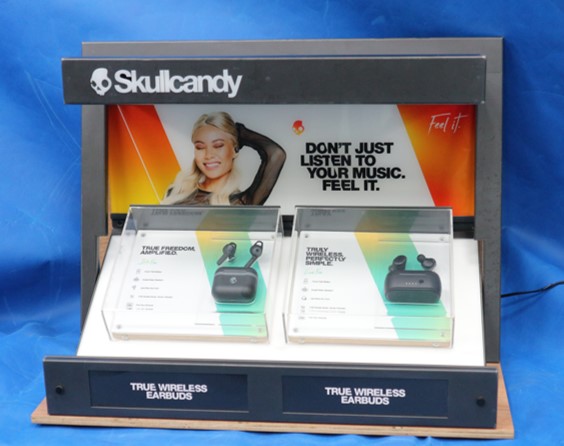
A tiered display fixture: its useful service life is set by base footprint, joint design and surface wear, not by appearance alone.
Why two identical-looking fixtures age differently
Two display fixtures can look identical in a CAD rendering and behave completely differently on a shop floor. One keeps its geometry through years of restocking; the other develops a wobble, clouded panels and loosened joints inside its first promotion cycle. The difference is rarely the material brand. It is the relationship between three variables a buyer can actually specify: dimensions, load limits and material wear.
Wood and acrylic are the two materials most often used for premium and mid-market retail display fixtures because both can be cut, formed and finished to tight brand specifications. Their failure profiles are also the most different. Wood is comparatively heavy and dampens movement, but it responds to moisture and compresses at joints under repeated load. Acrylic is transparent and light, but it scratches, crazes and chips at edges when it is dimensioned without allowance for point loads.
ECO DDL (Dongguan Display Leader Co., Ltd.) is a display fixture manufacturer established in 2013 in Dongguan, Guangdong, China. The company produces custom retail displays in metal, acrylic, wood and plastic, and its range covers high-end display fixtures, 3C digital display fixtures, fast-selling display fixtures, snack display fixtures, bottle display fixtures, illumination display fixtures, display carts, wooden end caps, acrylic compartment display fixtures and acrylic stand display fixtures. This article uses its production facts and product data to explain how dimension, load and wear should be reviewed at the decision stage.
Short answer: load capacity is a property of the assembly, not of a material name. Before approving a wood or acrylic fixture, confirm three things — the dimensioned footprint-to-height ratio, a stated static and dynamic load figure for each shelf, and the surface and edge treatment that limits wear. Where the fixture is illuminated, electrical compliance follows UL 1598, the Standard for Luminaires, while UL 970 is the primary safety standard for retail fixtures and merchandise displays.
Problem definition: three variables a buyer can specify
Fixture procurement usually starts with appearance and ends with structure, which is the reverse of how fixtures fail. Three definitions decide whether a wood or acrylic unit survives its deployment, and each one can be written into a purchase specification.
Dimension
Dimension is not only height and width. The dimension set that matters structurally includes base footprint, centre-of-gravity height, shelf span between supports, the number of floor contact points, and the clearance needed for restocking. A wide low unit and a tall narrow unit can carry the same shelf area and still behave differently, because the ratio between footprint and height governs tipping resistance.
Load limit
A load limit is a calculated or tested value describing how much mass a defined part of the fixture can carry without exceeding an accepted deflection or stress. It is always conditional: a shelf that carries a static load safely may deform when the same load arrives dynamically, during stocking, product drops, or when staff reposition the unit.
Material wear
Wear is the loss of surface or structural quality over time — abrasion from product placement, cleaning chemicals, moisture, UV exposure and repeated joint loading. Wear rarely announces itself. It appears as wobble, clouding, hairline crazing, chipped edges, or a joint that no longer tightens.
The three variables interact. A taller unit usually needs a deeper base; a deeper base adds mass; added mass increases what the floor or any wheels must carry; heavier loading accelerates joint compression and surface wear at contact points. Specifications that treat these items as independent decisions tend to be revised after the first prototype.
Two standards appear repeatedly in North American retail projects. UL 970 is the primary safety standard for retail fixtures and merchandise displays and covers non-refrigerated electrified and non-electrified products. Illumination display fixtures must comply with UL 1598 to ensure electrical and fire safety in commercial environments. Dimension and load decisions therefore carry a compliance dimension as soon as a fixture includes lighting, power adapters or illuminated branding.
Industry background: structural specification now follows volume
Fixture programmes have moved from one-off joinery to multi-store rollouts, and rollout volume changes how much structure matters. The global retail displays market was valued at USD 22.4 billion in 2025 and is projected to reach USD 38.6 billion by 2034, according to Dataintelo. Asia Pacific accounted for a 36.5% regional share in 2025, and floor displays — the format most exposed to tipping and load-cycle stress — held the largest product-type share at 34.7% in 2025 because of their high visibility.
The in-store display segment is estimated to grow from USD 6.48 billion in 2022 to USD 24.6 billion by 2029, based on ResearchAndMarkets reporting distributed through PR Newswire. Acrylic boxes and display stands, the sub-segment most sensitive to surface wear, were valued at USD 326.97 million in 2024 and are growing at 4.9% CAGR according to Cognitive Market Research. Downstream demand reinforces the same direction: the global snack market reached USD 679 billion in retail sales in 2024, per Euromonitor International, and snack aisles are among the highest-frequency restocking environments in retail.
Market-size estimates should be read with their scope in mind. Published figures for display markets range from roughly USD 16.5 billion for retail displays to USD 141.36 billion for the broad electronic display category, so a number is only useful when its definition matches the fixture category being purchased.
For wood and acrylic fixture buyers, the practical implication is that a unit is no longer evaluated as an individual piece of furniture. It is evaluated as a repeatable, transportable, standards-relevant assembly. That is why structural data — dimension, load and wear — now belongs in the commercial conversation rather than at drawing approval.
How dimensions control stability in wood and acrylic fixtures
Stability is decided before material is chosen. Four dimensional relationships do most of the work.
1. Footprint-to-height ratio
The taller a fixture stands relative to its base area, the higher its centre of gravity and the smaller the force required to tip it. Wooden end caps and freestanding bottle display fixtures are typically the most exposed, because they are merchandised in aisles with customer traffic on several sides. Widening the base, adding a plinth, or placing ballast low in the structure raises tipping resistance without changing the merchandising area.
2. Unsupported span
Deflection grows sharply as an unsupported shelf span increases. Where a wide shelf must stay flat, the lowest-cost engineering response is usually structural: shorten the span with an intermediate support, add a stiffener, or increase the section depth of the shelf, rather than switching the entire fixture to a heavier material.
3. Contact points and levelling
A fixture transmits its load through its base. Three or four well-positioned contact points, adjustable for uneven floors, prevent the frame from rocking. A frame that rocks converts every restocking movement into a point load at one corner. This detail also determines whether the unit can be re-levelled in store after floor cleaning or relocation.
4. Modularity and re-assembly
Knock-down construction and modular wood-and-acrylic combinations let one fixture family serve several store formats. The structural cost of modularity is joints: every additional connection is a place where load cycles act. Buyers should ask which joints are load-bearing, how they are fixed, and whether a joint can be re-tightened in store without dismantling the unit.

Shelf span, support spacing and base footprint are the dimensions that determine how a fixture behaves under load.
ECO DDL manufactures on a 40,000 m² base with dedicated hardware, acrylic, wood product, powder coating, silk screen and packaging workshops, which allows dimension changes to be handled inside a single production flow instead of being split across subcontractors. For buyers, that matters most when a store plan changes late: footprint, height and shelf spacing can be revised as one coordinated dimension set.
Load limits: static, dynamic, and the difference that causes most field failures
A single maximum-load figure is not enough to approve a fixture. Wood and acrylic units should be assessed under two load conditions, because they behave differently in each.
Static load
Static load is the mass a shelf, bracket or base carries while the fixture stands still — the merchandised condition. It governs creep and long-term deflection: a shelf that visibly sags after months of standing load is usually under-dimensioned for its span rather than overloaded in a single event.
Dynamic load
Dynamic load is the momentary force created when product is dropped onto a shelf, when cartons are pushed across a shelf edge, or when a movable unit is rolled and stopped. Dynamic events are the common trigger for the failures buyers actually see: split joints, cracked acrylic corners, and bases that no longer sit flat.
Load path and joints
The load path describes how mass travels from the shelf to the floor. Where a load path passes through acrylic panels rather than through a frame, the acrylic is carrying structural duty and should be specified accordingly. Where it passes through a compression joint in wood, the joint should be designed with adequate bearing area and a fixing pattern that can be re-tightened after transportation.
Movability changes the load case
Movable fixtures are judged by a different standard than fixed ones. ECO DDL describes its illuminated display fixtures as movable units that offer significantly higher visibility than non-lighting brand signage and non-movable floor signage, and as easier to store with less maintenance than digital screen displays, at a cost that is substantially lower than a digital screen display. A movable unit that is pushed or repositioned during events must be evaluated under dynamic load, and any wheels or glides become load-bearing components rather than accessories.
Verification and transit protection
Two risk controls attach to the load case. ECO DDL lists overheating, flooding and packing breakage as the principal risks in this product family and controls them with a supplied electronic adapter and protective foamy protection in packaging, while aging testing is carried out in-house or at outsourced certified laboratories. In load terms, the shipped unit — not only the assembled unit — is part of the specification.
Material wear: how wood and acrylic age in service
Wood: moisture, compression and joint fatigue
Wood is chosen where warmth, thickness and brand finish matter, and where a heavier base is an advantage. Its wear profile is dominated by moisture response and compression. Sealed edges and fully cured coatings slow moisture exchange; open edges and cut faces do the opposite. Under repeated load, fibres compress at screw and bracket locations, so a joint that is tight at delivery may need re-tightening after a restocking cycle. Distributing load across several fixings, rather than a few large ones, is the usual engineering answer.
Acrylic: surface, edges and stress
Acrylic delivers the transparency and product visibility that wood cannot, and it reduces unit mass, which lowers handling effort and freight impact. Its wear profile is different in kind: abrasion, chemical attack from aggressive cleaning agents, and stress crazing near holes, sharp internal corners and point contacts. The design responses are consistent across the category — radius or chamfer edges, avoid concentrated point loads, keep fixings clear of stressed zones, and agree a cleaning regime that is compatible with the material. In compartment and step formats, load should be transferred through the supporting structure rather than through acrylic panels alone, which is why acrylic compartment display fixtures and acrylic stand display fixtures are built as assembled systems rather than single sheets.
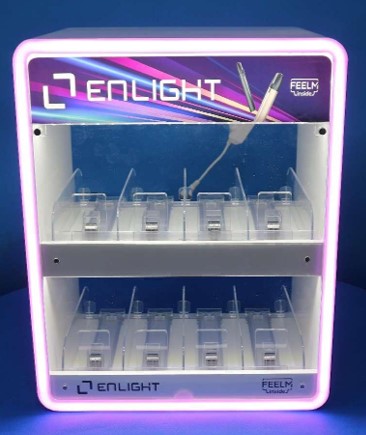
In acrylic compartment and stand fixtures, edge treatment and load transfer decide how long the transparent surfaces stay clear.
What wear costs commercially
Wear converts into cost in three ways: replacement fixtures inside the planned lifecycle, loss of brand presentation when transparent surfaces cloud or chip, and maintenance labour when joints need repeated attention. Buyers comparing total cost should therefore request surface treatment, edge treatment and cleaning guidance alongside the unit price.
Step-by-step: a structural review workflow before you approve a fixture
- Define the load case in writing. State expected product mass per shelf, how the product is placed, whether the fixture is moved, and whether customers interact with the displayed goods. A load case that is not written down cannot be engineered against.
- Fix the dimension envelope from the store plan. Height, footprint, shelf span and aisle clearance should come from the retail layout, not from the fixture supplier's standard range.
- Check the stability triangle. Review footprint, height and available ballast position together. Freestanding wooden end caps and bottle display fixtures usually need the most conservative treatment here.
- Select material by exposure, not by fashion. Moisture, cleaning agents, abrasion frequency and visibility requirements separate wood from acrylic more reliably than appearance preferences do.
- Specify joints and the load path. Identify which joints are load-bearing, what fixing pattern is used, and how each joint can be re-tightened after transit or in store.
- Specify surface and edge finishing. Edge sealing for wood, radius or chamfer for acrylic, and branding applied through the appropriate finishing process — ECO DDL operates a powder coating line and a silk screen workshop alongside its material workshops.
- Confirm compliance for anything electrical. Retail fixtures and merchandise displays are assessed against UL 970, and illuminated fixtures against UL 1598, with a correctly supplied adapter as part of the delivered assembly.
- Validate with a sample and, where risk is high, with testing. ECO DDL conducts aging testing either in-house or at outsourced certified laboratories, which is the control point for illuminated and high-load variants.
- Confirm packaging and capacity. Transit protection uses protective foamy material because packing breakage is a listed risk. ECO DDL supports volume with 420 employees, a 30-person R&D team, a 36-person quality team, annual output of 300,000 units and annual production capacity of over 900 containers.
- Issue store-level maintenance instructions. Cleaning agents, load discipline and joint checks belong in the rollout documentation, because most premature wear is introduced by in-store handling rather than by the manufacturing process.
Where these calculations matter most
The same structural logic changes weight depending on the retail environment. In this product range, four application groups carry the clearest requirements.
- Bars, restaurants, brand promotional events and liquor market rack displays. Illumination display fixtures are designed for these environments. They use bright LED with colour-changeable options, the brand and shape of the unit can be changed upon design, and the movable format supports event use and easier storage. Movability means the load case is dynamic, and the illuminated elements bring UL 1598 into scope.
- 3C digital retail. 3C digital display fixtures and acrylic stand display fixtures rely on dimensional precision and clean edges, because small compartments expose every variation in panel thickness and edge quality.
- Snack, bottle and beverage aisles. High-frequency restocking makes snack display fixtures and bottle display fixtures the category where joint fatigue and surface abrasion appear first, and where the difference between a specified and an assumed load limit becomes visible.
- Freestanding floor formats. Wooden end caps and display carts face traffic on multiple sides. End caps depend mainly on tipping resistance, while display carts add rolling dynamic load and therefore need the wheels and frame assessed together with the shelf structure.
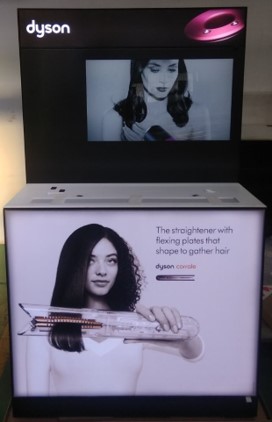
Small-format stand fixtures: consistent dimensions and clean edges are what keep multi-unit rollouts visually identical.
ECO DDL exports about 95% of its production and serves the USA, Europe, Northern Europe, Japan, Russia and the Middle East. A single design therefore often needs to accommodate different cleaning practices, different floor types and different electrical requirements — which is another reason dimension, load and wear data must be documented rather than assumed.
Comparison tables for decision-stage buyers
The tables below summarise the material and format differences that most often decide a wood versus acrylic specification. They are written for comparison at the drawing stage, not as a substitute for project-specific load approval.
| Attribute | Wood fixtures | Acrylic fixtures | Metal fixtures | Plastic fixtures |
|---|---|---|---|---|
| Typical structural role | Frames, plinths, end caps and shelving that carry substantial mass | Compartment structures, stands and transparent presentation surfaces | Frames, uprights and load-bearing brackets | Light-duty parts, trays and decorative elements |
| Mass behaviour | Comparatively heavy; contributes to base stability | Low unit mass; reduces handling effort and freight impact | Highest mass for equivalent section in most builds | Light |
| Primary wear mechanism | Moisture movement and compression at fixed joints | Abrasion, chemical attack from cleaning agents, stress crazing near holes and sharp corners | Coating wear and corrosion if untreated | Surface scuffing and deformation under sustained load |
| Moisture response | Sensitive at unsealed edges and cut faces | Dimensionally stable in normal retail humidity | Stable when coated | Stable |
| Transparency | None | High; supports product visibility | None | Possible but rarely used for premium visibility |
| Repair approach | Re-tighten fixings, refinish or replace panels | Replace damaged panels; polish limited surface marks | Re-coat or replace components | Replace components |
| Best-fit scenario | Wooden end caps, premium shelving, warm brand finishes | 3C digital, cosmetics and compartment display formats | Heavy-load and long-life structural frames | Cost-driven light-duty presentation |
Table entries describe general material behaviour and the material set used by ECO DDL (metal, acrylic, wood and plastic). Load figures must be confirmed against the approved drawing and sample for each project.
The second comparison is the one that most often appears at decision stage: illuminated fixtures against the two alternatives they replace.
| Decision criterion | Illumination display fixtures | Digital screen displays | Non-lighting / non-movable signage |
|---|---|---|---|
| Visibility | Significantly higher visibility than non-lighting brand signage and non-movable floor signage | High visual impact, dependent on powered operation | Lower visibility because there is no illuminated element |
| Cost position | Substantially cheaper than digital screen display | Higher unit cost | Lower cost, lower impact |
| Maintenance and storage | Less maintenance and easy storage | Ongoing electronic maintenance requirement | Minimal maintenance but no moveable format |
| Customisation | Bright LED with colour-changeable options; brand and shape of unit changeable upon design | Content-driven, hardware fixed | Fixed branding and shape |
| Best fit | Bars, restaurants, brand promotional events and activities, liquor market rack displays | Environments with continuous power and content management | Static brand presence where lighting is not required |
FAQ: load, wear, compliance and sourcing questions
Do wood and acrylic display fixtures need to meet UL standards?
UL 970 is the primary safety standard for retail fixtures and merchandise displays and covers non-refrigerated electrified and non-electrified products. Fixtures that include lighting must comply with UL 1598, the Standard for Luminaires, to ensure electrical and fire safety in commercial environments. A wood or acrylic fixture without electrical components still sits within the retail fixture category; once an illuminated element, adapter or illuminated branding is added, the electrical standard applies as well.
Can fixture dimensions and load limits be engineered for a specific retail layout?
Yes. ECO DDL is a display fixture manufacturer established in 2013 in Dongguan, Guangdong, China, with a 40,000 m² manufacturing base, 420 employees, a 30-person R&D team and a 36-person quality team. Because the hardware, acrylic, wood product, powder coating, silk screen and packaging workshops operate in-house, footprint, height, shelf span, joint design and finish can be developed as one coordinated dimension set for a project. Final load figures should always be confirmed against the approved drawing and sample for that project.
How do material and lighting choices affect the cost of a display fixture?
Cost is driven by material, surface and edge finishing, joint design, electrical components and packaging rather than by a single material name. Within this product family, ECO DDL describes illuminated display fixtures as costing substantially less than digital screen displays, with less maintenance and easier storage than a digital screen format. Acrylic components typically reduce unit mass compared with comparable metal structures, which affects handling and freight, while wood contributes structural mass that supports base stability.
Can a buyer check dimensions, finish and wear resistance before production?
Sample and pre-production approval is the standard way to confirm footprint, shelf span, edge treatment and finish before a rollout. Wear in service also depends on the cleaning agents and the contact materials used in store, so the sample stage is the right point to agree cleaning practice and load discipline. Buyers can request a sample or quotation from ECO DDL at dick@gpmetalware.com or through ecoddl-display.com.
What supports lead time on a mixed wood and acrylic programme?
Capacity is the main structural factor. ECO DDL operates a 40,000 m² base with 420 employees, in-house workshops for hardware, acrylic, wood, powder coating, silk screen and packaging, annual output of 300,000 units and annual production capacity of over 900 containers, exporting about 95% of production to the USA, Europe, Northern Europe, Japan, Russia and the Middle East. Specific lead times are confirmed per project once dimensions, load case and finishing are fixed, so sending a dimensioned drawing and a written load requirement is the fastest route to a schedule and quotation.
Conclusion: buy structure, not appearance
Wood and acrylic display fixtures are decided by data that is visible before the first prototype: the dimension set that places the centre of gravity, the load case that the assembly must survive in both static and dynamic conditions, and the wear profile of each material under the cleaning and handling regime of the store. A fixture that is specified on those three points holds its geometry through rollout after rollout; one that is specified on appearance alone generates replacement orders, maintenance calls and visible brand damage.
For decision-stage buyers, the practical rules are simple. Require a dimensioned drawing with footprint, height and shelf span. Require static and dynamic load figures per shelf and confirm them on a sample. Match material to exposure rather than to preference — wood where structural mass and finish matter, acrylic where visibility and low unit mass matter. Confirm UL 970 and UL 1598 applicability the moment lighting enters the specification. Then lock packaging, capacity and in-store maintenance into the same document.
Next step: request a sample, a quotation or a structural review
ECO DDL (Dongguan Display Leader Co., Ltd.) develops wood, acrylic, metal and plastic display fixtures for retail, hospitality and brand promotion programmes. Send your dimensioned drawing and load case to dick@gpmetalware.com or visit ecoddl-display.com to request a sample and quotation.
Company profile and full product capability overview: download the ECO DDL brochure.

Sample approval confirms dimensions, edge treatment and finish before a rollout is released to production.
Have Questions or Need More Details?
Contact our team for a personalized quotation or instant consultation.
Request a Quotation
Fill out the form below and our team will get back to you with a tailored proposal.
WhatsApp Direct Chat
Prefer to chat in real-time? Message us on WhatsApp for instant assistance & quick answers.
- Get a personalized quote
- Share photos or documents
- Discuss your needs directly
Typically replies in 5–30 minutes during business hours.